


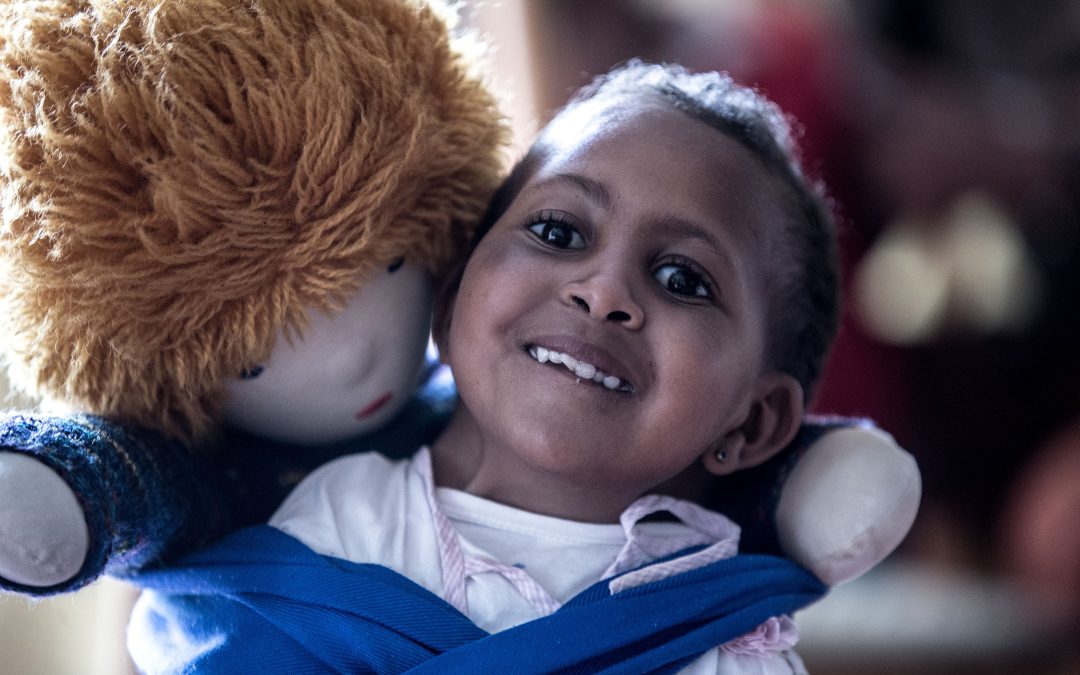
“The grass does not grow faster if you pull on it.”
(African proverb)
Identifying and treating developmental disorders and disabilities of a wide range of causes—the central concern of Social Paediatrics—plays a particularly important role in Eritrea in providing medical and interdisciplinary support for affected children and adolescents. The incidence of developmental disorders, accompanied by motor disabilities, perceptual disorders and intellectual disability, is significantly higher in Eritrea than in our part of the world.
The reasons are manifold: insufficient availability of medical and obstetric support, the lack of medical follow-up care and therapeutic support, undetected or untreated infections, malnutrition, oxygen deprivation during birth, and more. As a result, families are largely left to their own devices, and helplessness, shame and, in some cases, guilt feelings rooted in traditional beliefs—especially among mothers—lead to family isolation, hiding, and even the death of the affected children.

read more
In an admirable way, the Eritrean self-help organisation NAIDDE (National Association of Intellectual and Developmental Disabilities in Eritrea) has taken on the task of supporting these families and, as our cooperation partner in the Social Paediatrics project, is a stroke of luck and a model partner for sustainable development cooperation. The cooperation, which has been in place for several years, includes, among other things:
- several one-week workshops each year in which knowledge about causes, identification and support relating to the respective disorder or disability—such as autism, Down syndrome, early childhood brain damage and much more—is shared, and children and adolescents are given practical support
- EEG training and differential therapy for seizure disorders
- Teaching basic skills in autism therapy for parents and helpers
- Awareness campaigns, including in the remote regions of the country, including the production of a promotional film
- “Training of Trainers”, i.e. passing on what has been developed by trained Eritreans to other parents and helpers: help for self-help does not get any better than this!
NAIDDE has the will and the ability to implement and further develop the mammoth task of long-term, incremental support for these most vulnerable members of society with a level of sustainability that is as necessary as it is rare in a developing country.
The Social Paediatrics project team sees it as its task to support them as effectively as possible, including through future close cooperation—both in terms of space and personnel—with the POCA Paediatric Orthopaedics project team at Orotta Hospital in Asmara.
Project Management
Dr Thomas Dirksen, Child and Adolescent Psychiatrist, Münster


